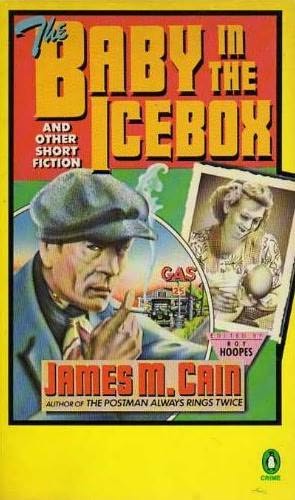
James M. Cain is dead enough. I read Postman and now Double Indemnity. I’ve been thinking about how to make a good gutter-American novel with a fastbuck bastard protagonist, so I read Cain. His short stories are great, as I wrote in the last post, but I really wanted to read the two first-person pov novels to learn, I hope, something about how he did it. I also chose Cain, I suppose, because he’s dead.
He’s dead and people still read him. There are plenty of popular writers now living to choose from, of course. Nora Roberts had 5 simultaneous New York Times bestsellers, last I checked. I’m not so sure people will read her books long after her death, though.
Everybody wants to sell. I want to sell. More important for me, though, would be to write books one could read twice or more without becoming bored. I could read Double Indemnity again, no problem. The ending is so beautifully weird. So nasty and poetic.
The patron saint of American writers who toil in obscurity, St. Nathaniel Hawthorne, wrote literature is “news that stays news.” I love that definition. My litmus for books, the ones I read and the ones I write, is always the same: if I can read it twice, and it’s just as interesting the second time, it’s good work. After revision, by my standard, I actually like about 1% of my own work. And I have my doubts about that 1%.
Cormac McCarthy has a bestseller at the moment—The Road. Once I’d finished reading it, all I wanted to do was read his previous novel, No Country for Old Men again. No Country seems a better novel to me than The Road. I want to read it again with greater urgency. Blood Meridian is better still. I read it in one day and night, then got up the next morning with the equivalent of a literary hangover and had the hair of the dog—I read it straight through a second time. I’ve read it twice more in the intervening years, and it’s still as interesting, or more so, each time. I know I’ll read it again in a couple of years. That, to me, is a very good novel.
So I want to write novels people will want to read over again. This much I know for certain. But of course, I have little positive idea what others will want to read once, let alone read again. Do people buying all those Nora Roberts vampire or romance novels read them over and over? Will people read them over and over in 20 years? I have my doubts.
Stephen King, when he complained about the little journals to an audience in San Francisco (see last post), said the writers of the fiction in those journals did not seem to care very much about catching a reader’s attention. He seemed to detect a sort of subtlety for subtlety’s sake that got in the way of writers grabbing a reader by the nostrils and yanking her forward. Ok, so there is a carnival-barker aspect to the kind of writing that sells. “Step right up, laidees and gentlemens, see a world of sex and violence you’ve never seeeen beeefore!” King sure knows about that. But some of his novels are clearly worthy of a second reading, I think. Some of them will last after King is in the ground. Of course, maybe after 50 novels, the odds are simply with him. How does one write novels that not only buy groceries, but turn into gold?
Ah, the alchemist’s stone. What is it? Being prolific, perhaps. Kinging out dozens of novels and getting some of them really, truly right. John Updike falls into that camp. I do not care for Updike’s work, myself, but I know he has written a hell of a lot of fiction and some of it will survive after he’s dead. But then, of course, there’s the J.D. Salinger scenario—only three novels and a book of short stories in fifty years, and everybody still knows his work, and they will continue to know it. William Gass, too. He doesn’t exactly roll them out every year.
The alchemist’s stone—what is it, what is it?